People use the words architectural photography and real estate photography as if they were the same, and in a casual conversation that is fine. In practice they describe two related activities with different purposes, different audiences and different rules about what the photographer is allowed to do. Understanding the difference is the first step to commissioning the right kind of work, and to recognising when an image is doing its job.
This guide explains both activities as disciplines, not as a list of tips for beginners. It covers what each one is, where they came from, what they share and where they part, what makes a photograph of a building or a home good in a conceptual sense, and why the way those images are used matters as much as the way they are made. It is written from the experience of working with agencies, architects, developers and holiday rental managers on the Costa del Sol, and it links to the articles where each topic is developed in more depth.
What architectural photography is
Architectural photography is the photography of buildings and the spaces they contain, made to show their form, materials, light and relationship with the surroundings. Its subject is the result of someone else's design work, and its first obligation is to that work: to understand what the architect or designer intended and to translate it into a flat image without losing it. A good architectural photograph says something true about a building that a visitor might take a long time to notice.
The genre is defined less by equipment than by a way of looking. It values accuracy and interpretation at the same time. A building must be shown with straight verticals, honest proportions and a clear reading of its volumes, and it must also be seen with intention: from the point of view that explains the design, in the light that gives its materials depth, at the moment that makes the space feel alive.
One of the foundations of the discipline is perspective control, which keeps vertical lines parallel instead of letting them converge, as they do when a camera is tilted upward. Encyclopedic references such as the Wikipedia article on architectural photography put that principle at the centre of the definition.
Architectural photography works at several scales. It can show a building in its setting, an interior as a sequence of spaces, or a detail: a texture, a junction, a staircase, the way a material meets light. It is documentary, because it records a work, and it is interpretive, because every choice of angle, height and moment says what the photographer thinks matters. That combination is why the best architectural photographers are often as good at understanding design as at handling a camera.
The work is also collaborative. The photographer needs to understand the project, the brief and the intended audience, which is why strong relationships with architects and interior designers produce better results. An image of a house can be accurate and still miss what the house is about. Knowing why a designer chose a material, a proportion or an opening is what allows a photographer to make that choice visible.
A short history, from the first photograph to the modern masters
Photography and architecture began together. The first permanent photograph, made by Nicéphore Niépce around 1826, was a view from a window that shows buildings and rooftops. A few years later, in 1835, William Henry Fox Talbot photographed a latticed window at Lacock Abbey, one of the images that established architecture as a natural subject for the new medium. Buildings were still, they were everywhere and they lent themselves to the long exposures that early photography required.
By the 1860s architectural photography was an established visual medium. Cities, monuments and public works were documented for governments, publishers and travellers, and photographers travelled to record them. In Spain, nineteenth-century photographers such as Jean Laurent built large archives of monuments and urban views that are still consulted today. The purpose of these images was largely documentary: to record, to inform and to circulate buildings that most people would never visit.
The early and middle twentieth century changed the approach. Photographers began to experiment with diagonals, bold shadows and unusual compositions, and architecture itself changed with modernism, which gave them new forms, new materials and new relationships between inside and outside. By the 1950s architects were commissioning photographers regularly, and architectural photography began to be considered an art form and not only a record.
Two names from that period are often used to explain the genre. Julius Shulman (1910 to 2009), based in Los Angeles, documented California modernism and became known for staging light and life so that a house looked as it was meant to be lived in. Ezra Stoller (1915 to 2004), based in New York, took many of the defining images of mid-century buildings with a more austere, documentary approach, and in 1961 he became the first architectural photographer to receive a medal from the American Institute of Architects. Between them they set the two poles of the discipline: the image that invites you into a space, and the image that explains a building.
What the pioneers still teach is simple to state and hard to practise. A building is not seen the way a camera records it, so the photographer's job is to mediate: to choose the moment, the light and the viewpoint that let the viewer perceive what a visitor would. Their images were not accidents of equipment but results of long observation, and the habit of looking before shooting remains the best predictor of quality in any property photograph, whatever the budget or the technology.
The digital era widened the field. Cameras became accessible, techniques that once required large-format equipment became available through software and specialised lenses, and the images reached new audiences through websites, portals and social media. That is also the moment when real estate photography became a discipline of its own, with a different purpose from the one the pioneers had in mind.
What real estate photography is
Real estate photography is the photography of properties made to communicate them to people who may buy, rent or book them. Its subject is also a built space, but its audience and its goal are different. An architectural photograph answers the question: what is this building and what does it express? A real estate photograph answers a more practical one: what would it be like to be here, and is this the right place for me?
That practical purpose shapes everything. The images must show a property accurately, because a person will visit it, stay in it or live in it, and they must show it attractively, because it competes with many other properties for attention. The balance between those two demands is the central craft of the discipline. A photograph that flatters without informing earns a click and loses a viewing. A photograph that informs without attracting is accurate and ignored.
It is also a discipline with constraints that architectural work often does not have. The photographer cannot choose the building, the weather, the furniture or the time of the year, and the property is usually occupied or about to be. The images are produced for a specific channel: a portal, a website, a brochure, a social media feed. And they are judged quickly, often in a few seconds and on a small screen, by someone who is eliminating options as much as discovering them.
That last point matters. Home buying is a process of elimination before it is a process of discovery. People who search online filter large numbers of properties and shortlist a few, and the first visual impression often decides which ones survive. In the United States, the National Association of Realtors reported in its 2024 profile of buyers that around half of them (50-55%) found the home they bought online. The Spanish market has its own figures, but where portals such as Idealista dominate the search, a similar pattern is reasonable to expect: the first visit happens on a screen.
It helps to say what the discipline is not. It is not decoration, and it is not advertising copy translated into images. Its job is not to invent an appeal that the property lacks but to bring out the appeal it has, and to do so in a way that survives a visit. The strongest real estate images are those that a buyer recognises when they walk in. That requirement, which looks like a limit, is also what makes the images valuable: they can be trusted.
Real estate photography also covers more than a single kind of picture. It includes interiors, exteriors, details, twilight images, aerial views and, increasingly, the material that goes with them: floor plans, virtual tours and video. We return to that visual kit later in this guide.
How the two relate: what they share and where they differ
The two disciplines share a visual language. Both rely on controlled perspective, careful composition, a deliberate treatment of light and a respect for the proportions of a space. A photographer who works well in one can usually work well in the other, and many do both. A real estate image made with the discipline of architectural photography is cleaner, more coherent and more credible. An architectural image made with an understanding of how people read spaces is more accessible.
Where they differ is in purpose, audience and freedom. The table summarises the main contrasts.
| Architectural photography | Real estate photography | |
|---|---|---|
| Purpose | To interpret and document a design | To communicate a property so it can be sold, rented or booked |
| Typical client | Architect, interior designer, developer, publication | Agency, owner, rental manager, developer |
| Audience | Peers, clients, readers, award juries | Buyers, tenants and guests |
| Freedom | Wide: viewpoint, moment and mood are authorial | Limited: accuracy and usefulness come first |
| Emphasis | Form, material, concept, atmosphere | Layout, space, light, lifestyle and honesty |
| Use | Portfolios, publications, awards | Listings, portals, websites, social media |
The boundary is not rigid. A new development may need both: architectural images that present the design and real estate images that sell the homes. A luxury villa may deserve an interpretive portrait of its architecture and a practical set that shows how it lives. Understanding which of the two a project needs is part of briefing a photographer well, and it prevents the frequent mismatch of expecting an editorial image from a commercial brief, or the reverse.
It also explains why real estate photography at a high level borrows so much from the architectural tradition. When the property has real design merit, the images gain by showing it with the same respect: straight lines, a point of view that explains the building, light that gives materials depth. The audience may be buyers instead of architects, but a well-designed house is still a well-designed house, and an image that shows it is more persuasive.
The visual language: perspective, camera height and composition
Three decisions define the look of a property image before light or editing enter the picture: how the lines are drawn, from what height the camera looks and how the frame is organised. They sound technical, but they are really about trust. Most people cannot say why an image feels right, yet they react to it at once.
Perspective and straight lines
When a camera is tilted, vertical lines lean. In a room they make walls seem to fall inward, and on the outside they make a building look as if it were toppling backwards. Perspective control, whether achieved with specialised lenses, with careful positioning of the camera or in editing, keeps verticals vertical and horizontals level. It is one of the clearest differences between an image that looks professional and one that does not, and it is a fundamental principle of architectural photography that real estate photography inherits.
The correction is not cosmetic. Straight lines make a space legible: you can read the proportions of a room, the height of a ceiling and the position of a window without distortion. An image with leaning walls forces the viewer to correct it mentally, and the effort registers as discomfort even when the viewer cannot explain it.
Camera height and the honesty of space
Where the lens sits changes how a room is perceived. A camera placed very high exaggerates floor area and makes ceilings seem lower, and one placed very low exaggerates ceiling height and hides the floor. A consistent, moderate height, adjusted to each room, keeps proportions natural and gives a whole set a shared rhythm. The same applies to wide-angle lenses, which are necessary to show a room in a small space but stretch corners and objects when pushed too far.
This is where the practical purpose of real estate photography meets its ethical side. An image that makes a room look larger than it is may win a click and lose a visit. Choosing a point of view that is flattering and truthful is a matter of professional judgement, and it is one of the reasons experienced photographers are easy to recognise: their rooms look generous but never impossible.
Composition: deciding where the eye goes
Composition is the arrangement of everything inside the frame so that the eye lands where intended and stays comfortably occupied. In a property that usually means the feature that makes the space special: a window frame that opens onto a view, a fireplace, a double-height ceiling, a terrace that continues the living room outdoors. Balance, leading lines, clean edges and a sense of depth do the rest.
The edges deserve as much attention as the centre. Half of a chair, a cut-off picture or a cable at the border pulls the eye away from the subject. Symmetry and clear sightlines give a calm, ordered image, which is why preparation of the space matters so much, as we explain below. For a fuller development of these criteria in a listing context, see our guide to what makes a quality real estate photograph.
Scale, depth and the sense of space
A flat image of a room does not convey how it feels to stand in it. Depth does. Placing a foreground element, such as the edge of a sofa or a doorway, gives the eye a starting point and makes the room recede. Layers of foreground, middle ground and background create a sense of distance, and recognisable objects such as chairs, tables or a staircase give the viewer a measure of size. When these cues are present, a space is easy to read. When they are missing, rooms look like empty boxes, and when they are exaggerated by an extreme lens, they look unreal.
Light: the main material of the photographer
Architects work with volume, material and light, and photographers work with the same three. Light is the one they control least and depend on most. It decides whether materials have depth, whether a room feels warm or cold, whether a view is visible and whether the image looks like the place feels.
Natural light and the eye
The most convincing property images respect the way people see rooms in person. Natural light is how a home is experienced, so photographs that keep its warmth and direction feel believable. The aim is not to make rooms brighter than they are but to preserve the balance a visitor would perceive, with consistent colour from one image to the next.
The problem of mixed light
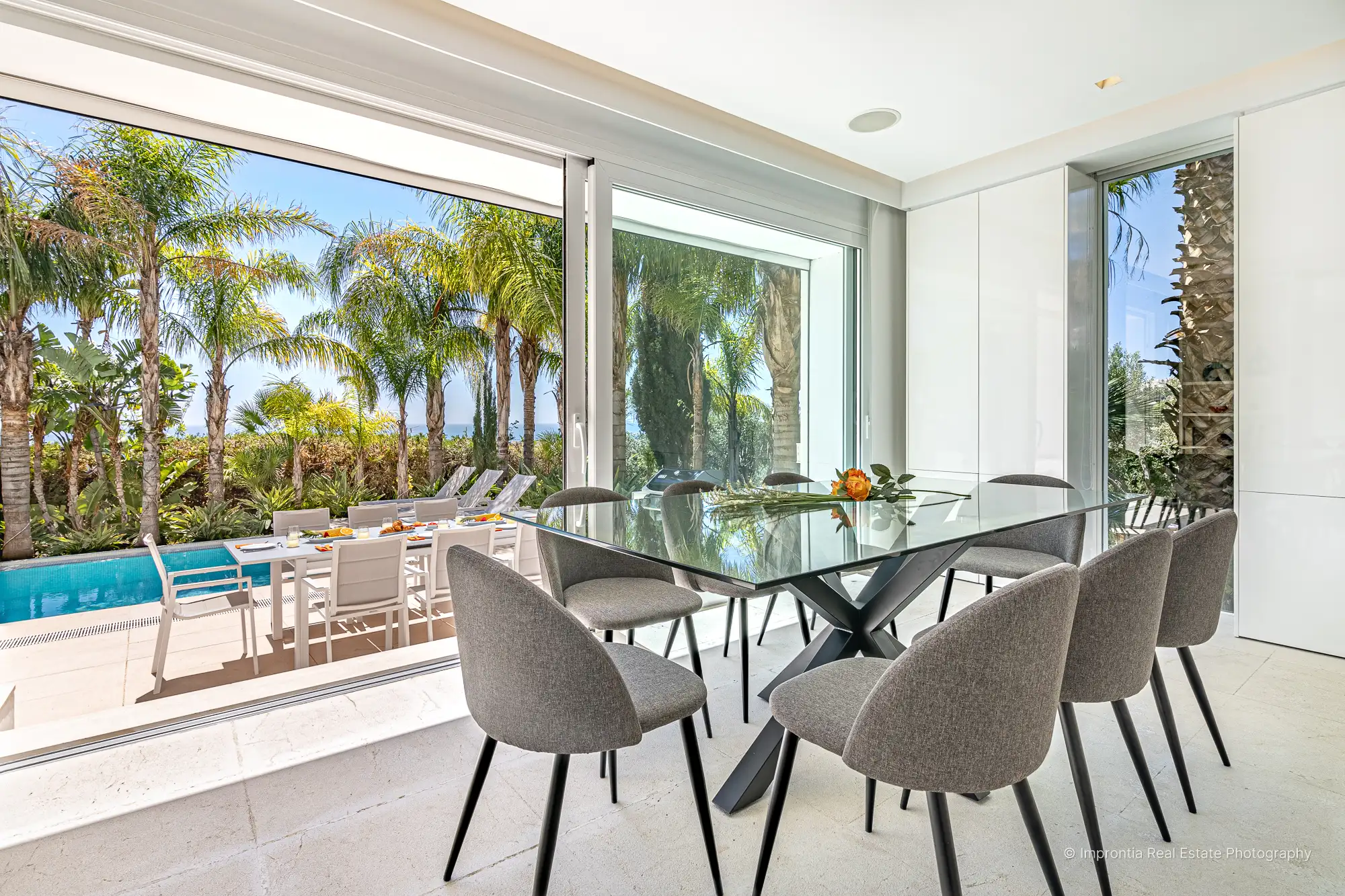
A fundamental difficulty of interiors is that the human eye perceives the bright exterior and the shaded room at once, while a camera cannot record both in a single exposure. The usual answer is to capture several exposures and combine them so that windows keep their view and the room keeps its detail. Mixed colour temperatures add a second problem, since daylight, warm bulbs and cool lighting each pull colour in a different direction. Handling both with control is a large part of what separates careful work from automatic work.
Colour and mood
The colour of the light changes the colour of the space. Morning light tends to be cool and clear, late afternoon light warm and golden, an overcast sky soft and neutral, and a lamp warm yellow. A photographer decides which of those moods the image will carry, and an editor makes sure it stays consistent across the set. When walls, wood and fabrics change tone from one image to the next, the viewer senses it even without being able to say why. Neutral, accurate colour is the foundation, and mood is built on top of it.
Time of day and orientation
There is no universal best hour. A room facing east tends to be at its best in the morning, a west-facing terrace in the late afternoon, and a room facing north needs bright, clear conditions because direct light barely reaches it. Exteriors tend to gain from the softer, warmer light near sunrise or sunset, while the high midday sun flattens volumes and hardens shadows. A cloudy sky acts as a natural diffuser, and it can suit some facades better than a clear one. Planning a shoot around the orientation of each space is a habit of experienced photographers, and it is one of the least visible forms of professionalism.
Twilight and artificial light
Twilight images combine the last daylight with the lighting of the property, and they often become the most memorable pictures of a set. The sky keeps a deep colour, interior lights glow and the building takes on an atmosphere that midday cannot give. They require precise timing and planning, and they work best when the architecture and the lighting design deserve the attention.
The kinds of image: interiors, exteriors, details and aerial views
A property is not described by one kind of photograph. Each type of image answers a different question, and together they build the picture a viewer needs.
- Interiors show how spaces are laid out, how light enters them and how they feel. They are the core of most sets, and they range from wide views that establish a room to tighter frames that show how spaces connect.
- Exteriors show the building in its setting: the facade, the garden, the pool, the terraces and the approach. They also reveal the character of the surroundings and, in places like the Costa del Sol, the seasons and the light that define it.
- Details capture textures, materials and finishes: a staircase, a lamp, a tile pattern, the grain of a wooden table. They give a set its atmosphere and give the viewer something to remember.
- Architectural elements focus on the structure and its distinctive features, such as geometry, symmetry, lines and materials. They are used by agencies, architects, designers and owners in listings, marketing material and publications, and they form a bridge between the two disciplines.
- Twilight images combine the evening sky with interior and exterior lighting for a particular mood.
- Aerial images show the plot, the surroundings and how the property sits in the landscape, which ground-level images cannot.


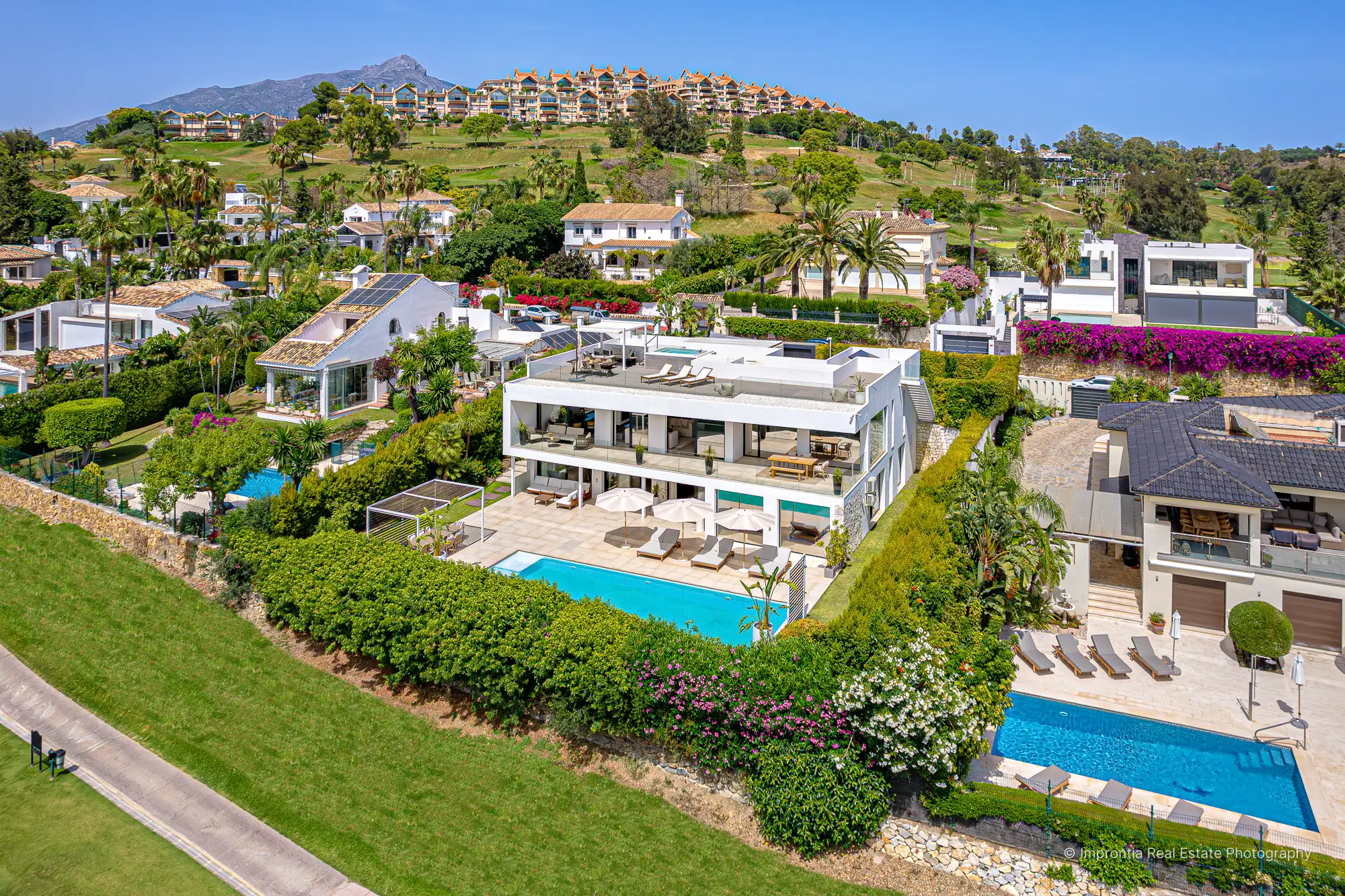
A good set is built like a story. It usually starts with the setting, moves through the exterior and the main living areas, then to bedrooms and bathrooms, and closes with the outdoor spaces and a few details. Not every corner needs to appear. The aim is to show how the property flows, with enough variety that no two images repeat the same idea. Aerial images deserve their own treatment, and we develop them in our article on aerial photos for listings.
Preparation and direction: the property as a stage
A photographer cannot redesign the building, but the state in which the building is presented can change the result completely. Preparation is therefore part of the work, not a favour to the photographer. The goal is not to redecorate but to remove distractions: to leave the spaces clean, ordered and free of the small objects that draw the eye away from the architecture.
Cleanliness comes first. Surfaces cleared, floors clean, curtains open so that natural light enters, cables hidden, pictures straight, cushions arranged. The aim is symmetry, clear sightlines and a calm, balanced atmosphere. A few simple adjustments are usually enough for a home to look ready. In kitchens and bathrooms, clearing counters except for one accent piece reads as order, while in bedrooms smooth bedding and a centred picture over the bed bring calm to the frame.
The outdoors needs the same care. Cars moved, garden furniture tidy, the pool clean, vegetation cut back where it hides the house. Seen from above or from a distance, small things become visible. Our property preparation guide lists what to do before a session, and it is designed to be shared with owners.
Direction belongs to the photographer. A good professional decides the viewpoints, the order of the session, the moment to photograph each space and how much of the scene to include, and does so with the brief and the audience in mind. That is a form of authorship even in a commercial context, and it is why clear communication before a shoot matters. When the photographer knows who will see the images and where they will be published, the decisions improve. When the owner or agency understands what the photographer needs, the session runs better.
Roles matter on the day. The owner or agency provides access, prepares the property and, ideally, leaves the space free of people and other activities. The photographer decides the order, the viewpoints and the timing. A short briefing beforehand, with the audience, the channels and the key features of the property, saves time and improves the result. Clear expectations on both sides are worth more than any piece of equipment.
Post-production: what editing is and where it stops
Editing is a stage of photography, not an optional extra. A raw file records what the camera captured, not what the eye perceived, and the editor's task is to close that gap. In architectural and real estate work, the essentials are well defined: straightening verticals and horizontals, correcting lens distortion, adjusting exposure and white balance, combining exposures where windows and interiors need it, keeping tones consistent across the set and cropping for better composition.
Done well, none of that is visible. The viewer simply sees a room that looks the way it feels to be in it. Done badly, it is obvious: haloes around windows, flat grey shadows, colours that change from one image to the next. This is why the technique of combining exposures is not good or bad in itself. It is the control with which it is applied that makes the difference. Hand-finished editing takes longer than a batch preset, and the result shows in the details.
The difficult question is where editing should stop. A useful rule is that an edit is acceptable when a buyer who later visits the property would not feel misled. Correcting a distorted wall, balancing a dark corner or keeping a white wall white is legitimate. Changing the structure, adding views or features that do not exist or hiding defects that a visitor will find is not. Between those extremes lie practices that need to be agreed in advance, such as removing temporary objects, changing the colour of vegetation or replacing a sky.
In our standard editing we correct perspective and framing, adjust exposure, highlights and shadows, white balance, temperature and tint, lens distortion and aberrations, and use merged exposures to make the most of the dynamic range. Removing objects, changing the colour or texture of objects or vegetation, replacing skies and applying edits generated by artificial intelligence are not part of it. If a client needs one of them, it is requested and agreed separately. That boundary is a deliberate position on honesty, not a technical limitation.
Standards also evolve. Interiors that once relied on rich colours have moved towards light, neutral palettes, and the techniques that enhanced saturated colours can wash out modern interiors. A professional adapts to current design trends while keeping accuracy as the constant.
The complete visual kit: photographs, floor plans, tours and video
A single kind of image rarely tells the whole story. Photographs show condition and atmosphere, but they do not show structure, they cannot be walked through and they do not move. That is why the modern practice of marketing a property treats photographs as the lead piece of a kit that also includes other assets, each with its own task.
- Photographs attract attention and convey condition, light and atmosphere.
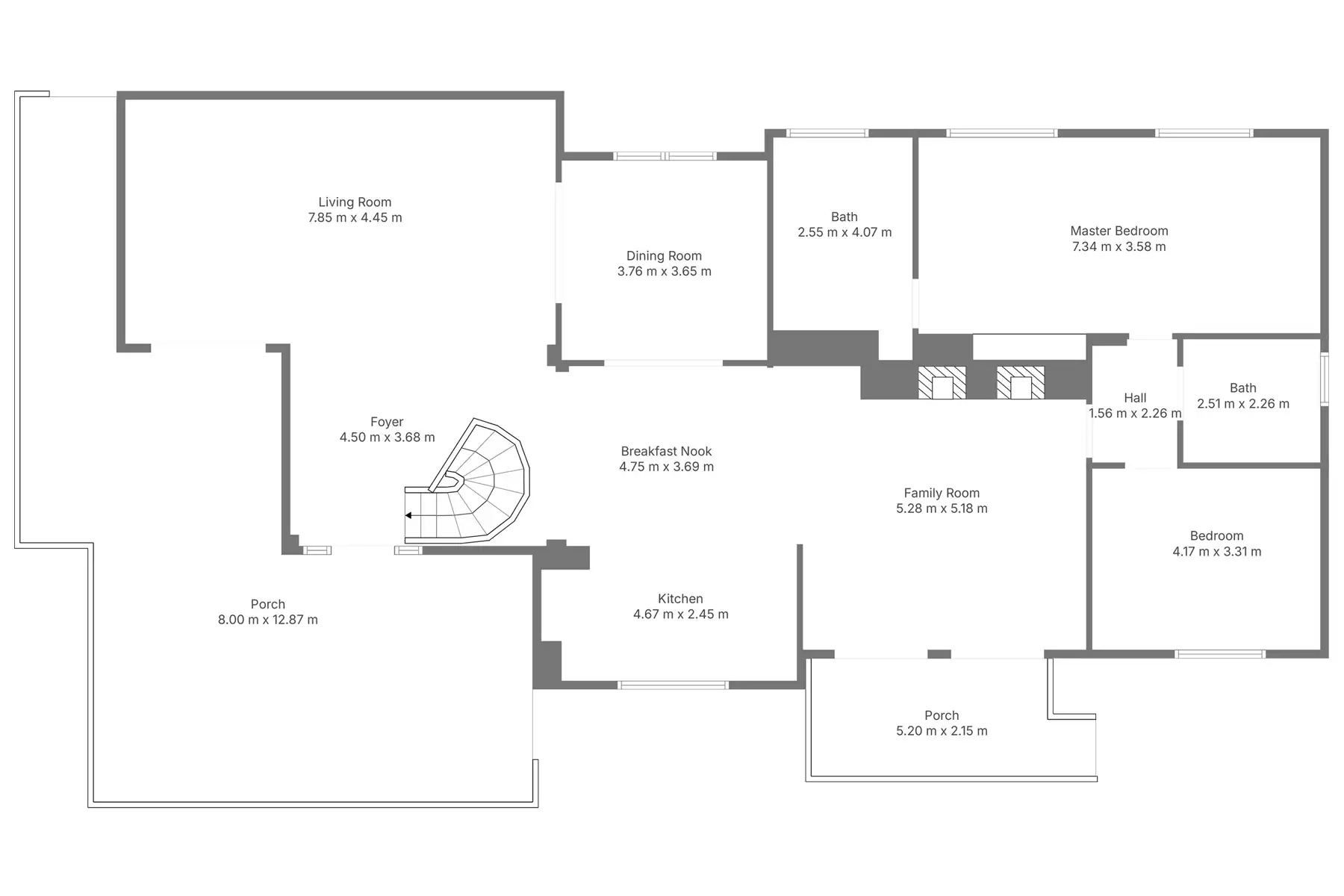
- A schematic floor plan explains the layout: how many rooms there are, how they connect and how large they feel in relation to each other. We explain how it works in our article on schematic floor plans, and how to make them a standard part of every listing in floor plans for listings.
- A 360° virtual tour lets interested viewers walk through the property from any device, which is especially useful for remote buyers and for larger or more complex properties. Our guide to the 360° virtual tour develops when it helps and what to ask a provider.
- Video adds movement and time, from a walkthrough to an aerial approach to the house.
- Virtual staging furnishes an empty property digitally so that viewers can judge scale and use. When furniture is added digitally, it is good practice to present it as such.
Each piece answers a question the others cannot. Seen together, they let a viewer understand a property thoroughly before visiting, which is what a modern listing is for. They also share a requirement: they must look as if they belong to the same project. Consistent colour, consistent style and a consistent level of care make the kit feel coherent, and a mismatched piece weakens the whole.
The same logic applies to delivery. Images are produced for several uses, from portals and websites to social media and printed material, and they need the right formats and proportions for each. Organising the files, keeping names consistent and delivering them in good time is part of the professional service, not an administrative detail.
Quality and honesty: how to recognise a good image
With the pieces above in place, a conceptual definition of quality becomes possible. A good property or architectural image is accurate, because it represents the space as it is. It is clear, because the eye knows where to go. It is coherent, because it belongs to a set with a common treatment of light and colour. It is attractive, because it shows the property at its best. And it is useful, because it answers the question the viewer has.
Honesty sits under all of these. The point of view, the light and the composition shape perception, and they should do so in the service of the property and not of illusion. A viewer who is helped to understand a home trusts it. A viewer who feels misled at the viewing distrusts the whole listing, and the agency behind it. Trust is the most valuable thing a set of images builds, and it is hard to recover once lost.
It is just as useful to say what quality is not. It is not gloss: heavy saturation, extreme contrast and artificial skies make an image striking and, often, untrustworthy. It is not quantity: a long set of similar frames dilutes the few that matter. It is not the most dramatic wide angle available: a room that looks twice its size is a promise the visit cannot keep. Restraint is a sign of professionalism, and it is usually what separates durable work from work that dates quickly.
It is possible to test an image with a few questions. Do the walls stand straight? Do the windows show their view and the room keep its detail? Do the colours look natural and consistent across the set? Are the edges clean? Is there variety in angle and distance? Does the set follow the path of a visit? Could you walk in and recognise the place? Our article on a quality real estate photograph turns these questions into a ten-second test for any set of property photographs.
The same questions are the basis for choosing a photographer. A portfolio that shows complete shoots rather than a selection of highlights, a consistent style across different properties, a clear explanation of what the editing includes and what it leaves untouched, and references from agencies who work with the photographer regularly are better guides than any title. We develop this in our guide to choosing a real estate photographer.
Who commissions it, and why
The people who commission this kind of photography do so for different reasons, and the reason shapes the brief. A good brief is short and concrete. It says who will see the images, in which channels they will be used, which features of the property matter most, what mood is wanted and what else will be produced alongside the photographs, such as a plan or a tour. It also states the deadlines and who will have access to the property. With that information, a photographer can plan the shoot and avoid the most frequent cause of disappointment: a result that is good but not what was needed.
Architects and interior designers
For architects and interior designers, images are a professional tool. They document completed work, build a portfolio, support publication in specialised media and help attract the right clients. The brief tends to centre on design intent, materials and atmosphere, and the photographer needs to understand the project as well as photograph it.
Developers and builders
Developers and builders use images to present finished homes, to show how buildings relate to their surroundings and to document progress. Their material serves both the design narrative and the sales effort, so it often combines architectural and real estate approaches.
Agencies, owners and managers
Real estate agencies and owners need images that help properties sell or rent. Their priority is accuracy, appeal and consistency across a portfolio. Vacation rental agencies and property managers add a second need: guests book from the images and judge the stay against them, so the way the beds, the terraces and the views are shown sets expectations. Honest, consistent images are part of the service they provide.
Hospitality, retail and other spaces
Hotels, restaurants, shops and offices also commission photography of their spaces, both to attract customers and to help future staff and visitors picture themselves in them. The same principles of perspective, light and honesty apply, adapted to the use of the space.
The Costa del Sol: light, architecture and an international audience

Context matters. On the Costa del Sol, the light is strong, the sun is present for much of the year, and many properties combine large glass surfaces, white volumes and terraces that extend rooms outdoors. That makes the contrast between a bright exterior and a shaded interior a daily challenge, and it makes the handling of light more important than almost anywhere. A room that looks inviting in person can look flat or dark in a photograph if the light is not managed.
The architecture is varied. Contemporary villas with clean white lines stand beside traditional Mediterranean houses with tiled roofs, arched openings and wooden beams, apartments in developments with shared gardens and rural properties on sloping land. Each calls for a slightly different approach: geometry and reflections in a modern villa, texture and warmth in a traditional one, setting and views in a hillside property. A photographer who knows the area understands those differences before arriving.
The audience is also particular. Many buyers, guests and renters are international, in different time zones and with different languages, and they often see a property for the first time on a screen, long before visiting. For them, the images and the material that complements them carry more weight than usual, which is why a complete visual kit, with a plan and a virtual tour for the right properties, is so common in this market. Whether the project is a family home, a holiday rental or a development, the principles in this guide apply: show the property truthfully, show it well and show it consistently.
How the discipline is changing, and what stays constant
The tools around property images change quickly. Aerial photography and virtual tours have moved from novelty to expectation in many markets, transitions from day to dusk are used to make a listing stand out among similar ones, and artificial intelligence now appears in editing and in virtual staging. New possibilities arrive every year, and it is tempting to treat each one as a revolution.
The principles change much more slowly. Every new tool faces the same questions as the old ones. Does it help the viewer understand the property? Does it show it truthfully? Does it fit with the rest of the material? A technique that helps is welcome, and one that misleads is not, however impressive it looks. That is also why the decision about where to use artificial intelligence, which edits to apply and how to label digital furnishing is a matter of judgement and honesty and not only of technology.
What stays constant is the craft underneath: perspective that keeps lines straight, light that respects the space, composition that guides the eye, preparation that removes distractions, editing that corrects without inventing and a coherent set that tells the property as a story. Whoever masters those foundations can adopt new tools without losing their way, and whoever commissions the work can use them as criteria for choosing.
If you want to see these ideas applied, our page on real estate photography in Marbella and the pages on aerial photography, schematic floor plans, 360° virtual tours and virtual staging show the complete range of what we do.
Frequently asked questions
-
What is architectural photography?
It is the photography of buildings and the spaces inside them, made to show their form, materials, light and design intent. It values perspective control, accuracy and interpretation, and it is commissioned mainly by architects, designers, developers and publications.
-
What is real estate photography?
It is the photography of properties made to communicate them to people who may buy, rent or book them. It aims to show a property accurately and attractively, and it is used in listings, websites, portals and social media.
-
Are architectural and real estate photography the same thing?
No. They share techniques, but their purpose differs. Architectural photography interprets a design and often serves the architect, while real estate photography serves a sale or a rental and the person who will decide on it.
-
Who commissions architectural photography?
Architects, interior designers, developers, builders, hospitality and retail companies, landscape designers and publications. Each uses the images to present a project, build a portfolio or reach the right audience.
-
Does a good camera make a good property photograph?
It helps, but it does not decide the result. Light, point of view, preparation and editing weigh more. A larger sensor gives more room to handle bright and dark areas, and judgement decides what to do with that room.
-
How long does a property shoot take?
It depends on the size and complexity of the property and on the services involved. A standard property usually takes between one and two hours on site, and large villas take longer. The quote states the estimated time.
-
How much editing is acceptable in a property photograph?
Correcting verticals, balancing exposure and colour and keeping tones consistent is standard practice. Changing structure, adding features that do not exist or hiding defects is not. If a buyer would feel misled at the viewing, the edit has gone too far.
-
What does a complete visual kit include?
Usually photographs plus a schematic floor plan and, for larger or more complex properties, a 360° virtual tour. Aerial images, video and virtual staging complete the kit when the property calls for them.